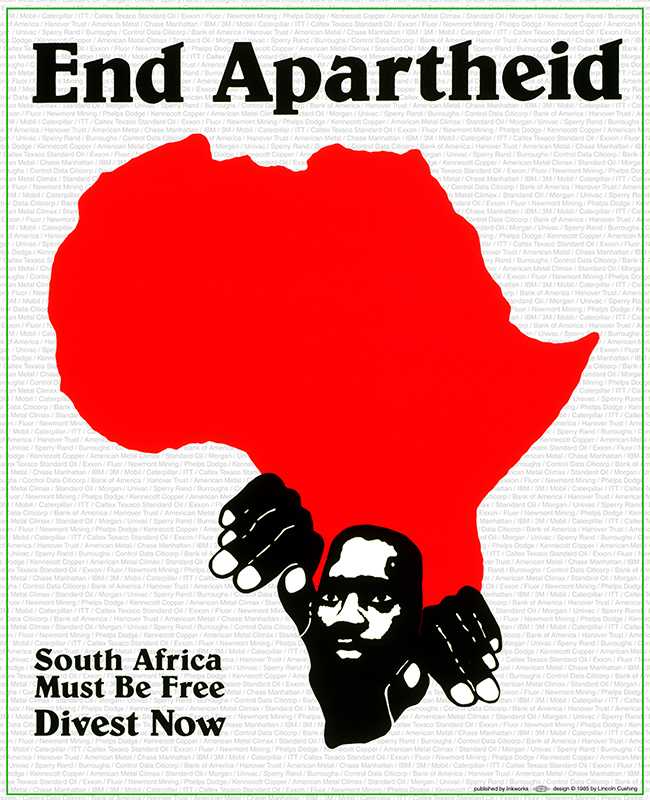
End Apartheid poster:
achieving visibility
Lincoln Cushing, October 11/4/2026
Recently a Facebook photo by a visitor to the Obama Foundation Museum in Chicago showed my 1985 “End Apartheid” front and center in their “Yes, we can” display of social activism, right next to a United Farm Workers flag (coincidentally, the UFW holds the trademark to the “Si se puede” slogan and that eagle). That museum is a prominent institution that will draw many visitors, but this was a surprise to me. I have work in other collections, including the Cooper Hewitt - Smithsonian Design Museum (donated by Steven Heller), but its presence in this space calls the question – how did that poster get selected? What makes a poster “special”?
It had to work its way up. And it took a village.
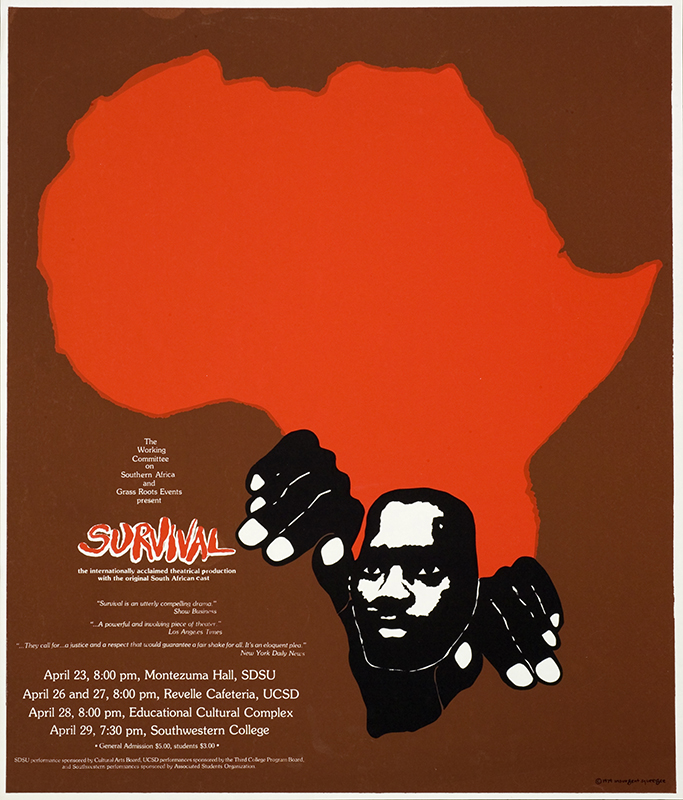
The image began in 1979 as promotion for “Survival,” a nationally-toured theatrical production performed by four exiled Black South Africans - Selaelo Maredl, Fana Kekana, Themba Ntinga, and Seth Slbanda. I was the graphic artist for the Working Committee on Southern Africa and Grassroots Events, and we sponsored four shows in the San Diego area. I took one of the actor’s publicity photos and positioned him climbing out of the African continent and I screen printed a limited edition large three-color poster. We had a union shop print a one-color version for broader distribution. The subject was very controversial, and one showing at UC San Diego was temporarily stalled by a bomb theat.
By 1985 I’d moved up to the San Francisco Bay Area and was working with the community offset shop Inkworks Press. The anti-apartheid movement was in full force, and we wanted to make a visual contribution. Since the political objective was divestment, I added an extensive list of US corporations doing business with South Africa in faint type filling the entire space around Africa.
A poster is useless if it just sits on a pressroom floor, so we partnered with the main movement distributor in the US, Syracuse Cultural Workers. At the time mail order was one of the principal methods for publicizing and disseminating posters, and these became very popular. The Los Angeles Weekly used it to promote a 1986 anti-apartheid exhibition at the Watts Towers Arts Center. Subsequently, it’s been used in textbooks and art history surveys. The Survival and the End Apartheid posters are featured in Michigan State University’s African Activist Archive and in the South African History Online site.
In 2014 graphic artist Micah Bazant designed a poster about Palestine, a meticulous visual homage to my 1985 version down to the slogan, image, typeface, colors, and corporate targets.
This poster’s presence at the Obama Museum honoring grassroots activism supports my thesis about the life cycle of a cultural artifact – successful artistic efforts don’t happen in a vacuum, they involve many steps and many hands. My name is visible, but not that of the typesetters, printers, catalogers, curators, distributors, and writers. Honor that village and keep art alive.
Return to Docs Populi / Documents for the Public