In defense of Henry J. Kaiser’s WWII ship quality
Lincoln Cushing. Originally published in the Kaiser Permanente "History of Total Health" blog 1/25/2016, republished 3/30/2026
In The Finest Hours: The True Story of the U.S. Coast Guard’s Most Daring Sea Rescue, authors Tougias and Sherman set the stage for the sinking us the SS Pendleton. The authors make the case that this T2 tanker, which broke in half on February 18-19, 1952, was a disaster waiting to happen.
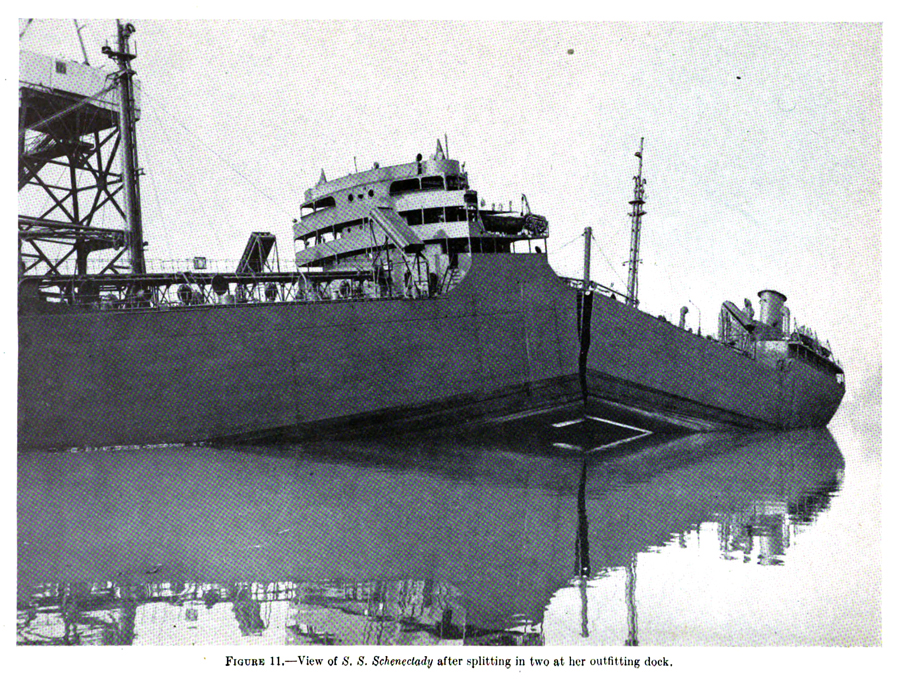
“…These ships had gained a more dubious nickname, and some critics referred to them as “serial sinkers” [referring to the conventional non-military ship designation SS, for “steam ship”] and “Kaiser coffins”. The trouble with T2 tankers dated back nearly a decade, beginning on January 17, 1943, when the Schenectady split in half while still at the dock! The ship had just completed its sea trials and had returned to port at Swan Island, Oregon, when suddenly she cracked just aft of the bridge superstructure. The center portion of the ship buckled and lifted right out of the water, leaving its bow and stern to settle on the river bottom. Like the Schenectady, the Pendleton had been built hastily for the war effort.”
“But the ship's strong outward appearance concealed the subpar welding methods used in its construction. As in many T2 tankers built during that era, the hull of the Pendleton was most likely put together with "dirty steel" or "tired iron," in other words, steel weakened by excess sulfur content.”
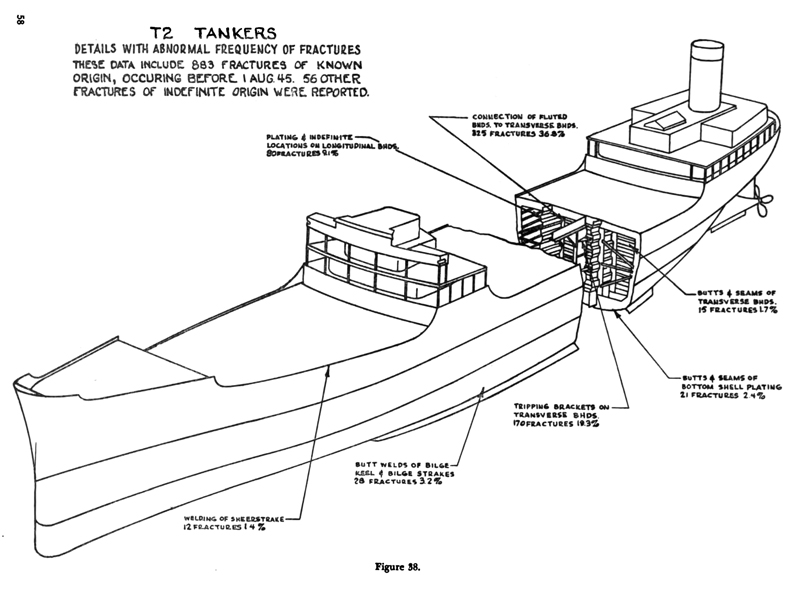
“The ship had suffered a three-way fracture in the bulkhead between number 4 starboard and center tanks just one year before in January 1951. The three-way fracture had never been repaired. Amazingly, the Pendleton passed its last Coast Guard inspection on January 9, 1952, in Jacksonville, Florida, with flying colors.”
Some of these criticisms are erroneous, and some are incorrect.
1. The “Serial sinkers” and “Kaiser coffins references were not commonly applied to the T-2 tankers, or even to the Liberty and Victory class cargo ships – they referred to the Kaiser’s Escort Aircraft Carriers, or CVEs. These vessels, with initials that were derisively said to mean “Combustible, Vulnerable, and Explosive,” were built for the Navy yet were extremely thinly armored – by design.
2. Missing from Tougias’ and Sherman’s account is the fact that in July, 1951, the SS Pendleton ran aground in the Hudson River near New York and refloated the next day. The part of her hull impacted by the grounding was the same section where the ship was to break nine months later. Whether the grounding was a factor in her breaking up will never be determined.
3. Wartime shipbuilding was always a work in process, with hard lessons and new advances occurring on very short timetables. During World War II, welding ships was a relatively new process, and the civilian workforce was relatively inexperienced. The Schenectady was the first all-welded tanker built by the Kaiser Company, launched in late 1942. Improving productivity without risking worker safety was a major priority, and this was effectively accomplished, War materiel produced during war is never expected to last very long, just long enough to do the job.
4. Manufacturing steel for welded ships was also a work in progress, and at the beginning little was understood about the impact of “brittle steel,” especially when exposed to cold-weather duty (the air temperature when the Schenectady broke was 23 degrees Fahrenheit). As problems arose, manufacturing and processes improved.
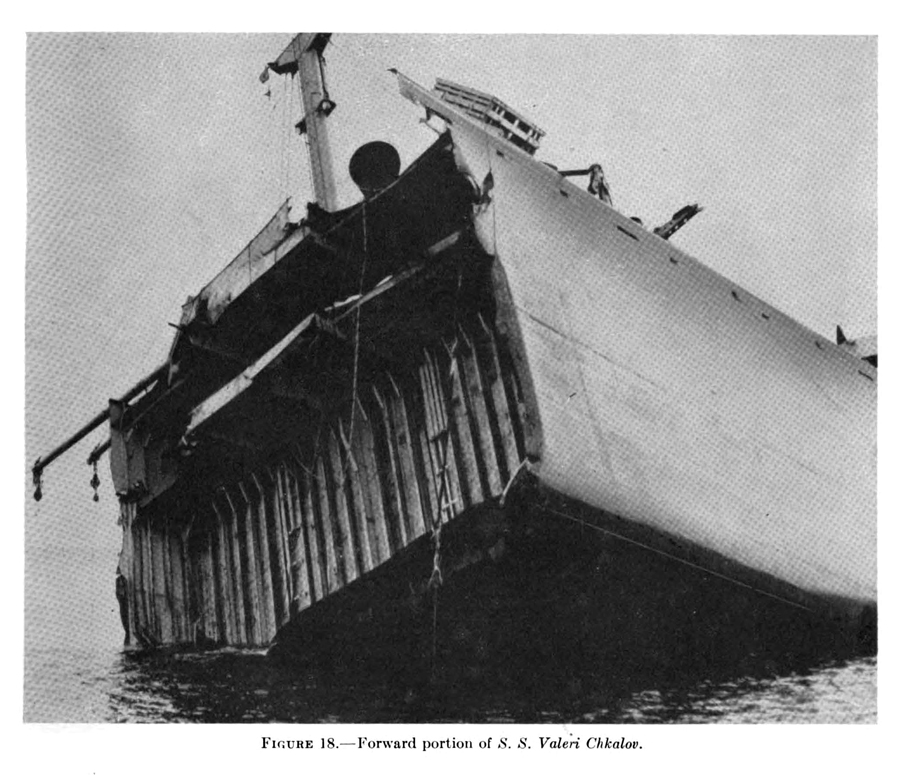
5. Perhaps most importantly, the overall record of all the wartime-built ships was impressively safe. In July, 1945 the Secretary of the Navy established a blue-ribbon panel to look into this problem; in 1947 they issued their Final Report on a Board of Investigation to Inquire into the Design and methods of Construction of Welded Steel Merchant Vessels. Their review of the 4,694 merchant vessels built during the war, only 25 sustained a complete fracture of the “strength deck” or bottom. Of those, eight were lost at sea and two – including the above mentioned Schenectady – broke in two but were not lost. And the human cost? A total of 26 lives were lost as a result of structural failures.
The Board’s conclusions were laid out on page 10:
(a) The fractures in welded ships were caused by notches and by steel which was notch sensitive at operating temperatures. When an adverse combination of these occurs the ship may be unable to resist the bending moments of normal service.
(b) The serious epidemic of fractures in the steel structure of welded merchant vessels has been curbed through the combined effect of the corrective measures taken on the structure of the ships during construction and after completion, improvements in new design, and improved construction practices in the shipyards.
(c) Locked-in stresses do not contribute materially to the failure of welded ships.
(d) Existing specifications are not sufficiently selective to exclude steel which is notch sensitive at ship operating temperatures.
(e) A tendency for certain ships to incur repeated casualties can be measured but the trend is not great and the effect is not significant.
(f) The basic analytical method used in calculating nominal stresses in the main hull girder under a known bending moment is valid.
(g) The overall strength of the Maritime Commission ships is satisfactory.
An excellent source on this subject is Ships for victory; a history of shipbuilding under the United States Maritime Commission in World War II. Lane, Frederic Chapin. 1951. Baltimore: Johns Hopkins Press.
Return to Docs Populi / Documents for the Public