An Industrial Revolution All Their Own:
World War II Women Stand Up for Equality
Lincoln Cushing.
Originally published in the Kaiser Permanente "History of Total Health" blog 2/18/2018, republished 4/10/2026
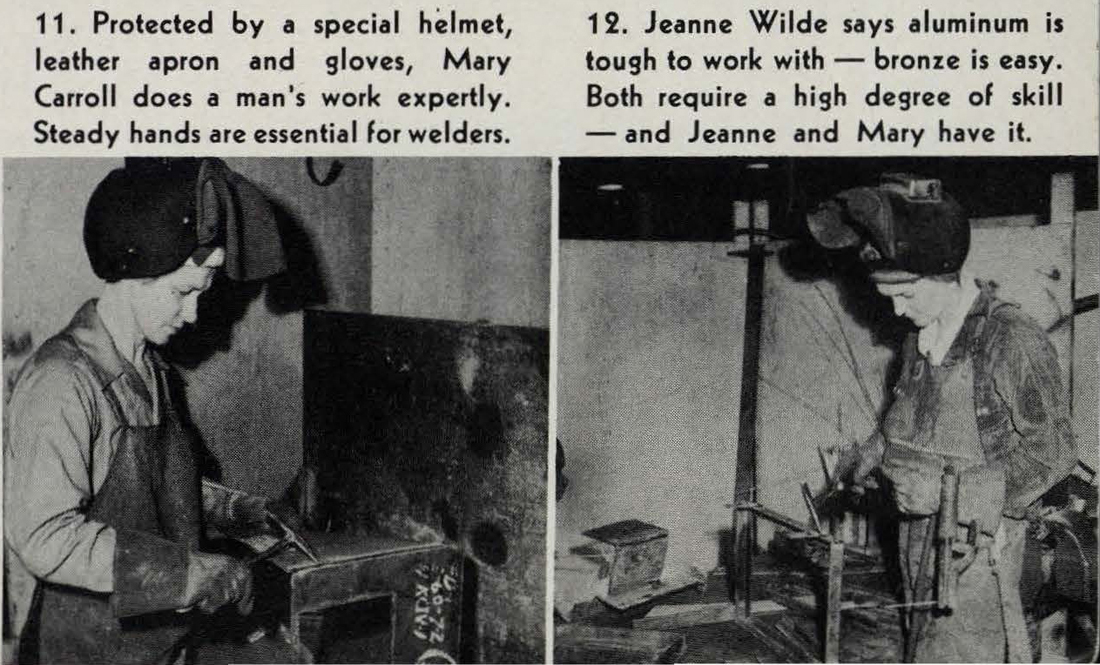
In April of 1942, Mary Carroll, Jeanne Wilde and Louise Cox reported for duty at Kaiser shipyards in Portland, Oregon, and Richmond, California — the first women to work as welders in America’s ship-building industry.
Carroll, Wilde and Cox were at the tip of a movement that turned industry and labor relations upside down during the war. After the attack on Pearl Harbor on December 7, 1941, everything had changed. The standard industrial shipyard workforce, which for generations had been composed of healthy white men, found their ranks depleted as those workers joined the military.
Thousands of other women later joined these three, earning good wages and going where women had never been before. The home front was a watershed moment in the struggle for equal opportunity, when women stood up for the right to work alongside men despite hurdles that included resistance from labor unions.
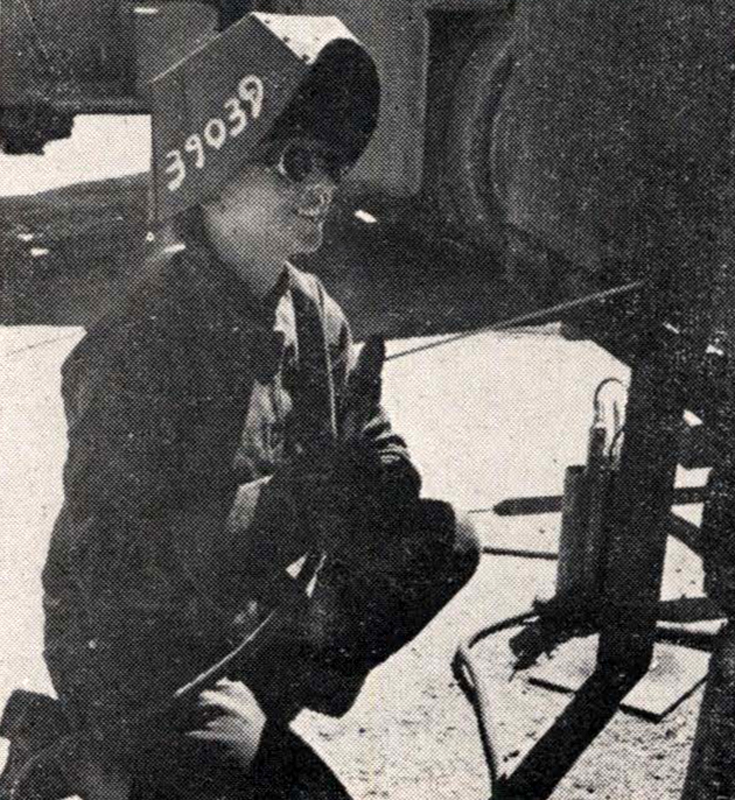
Carroll and Wilde started working at the Kaiser shipyards in Portland after completing welding school. Carroll was a Gold Star Mother, having lost her 27-year-old son in the fighting on Bataan. Louise Cox was also hired in April. She was the first woman welder trainee at Kaiser Richmond’s Shipyard 2, replacing her brother on the production line after he joined the Navy.
Massive Labor Migration
Who was left to build ships after men went to war? Everybody else, except for Japanese-Americans who were sent to internment/concentration camps. A massive labor migration to defense industries began. And the most difficult labor decision Henry J. Kaiser faced was how to handle union opposition to accepting the new workforce in his shipyards.
An Associated Press news story from November 1942 — less than a year after Pearl Harbor — pointed out that women had “managed to accomplish an industrial revolution all their own within a very short time” through the first large-scale unionization of women, winning the first legislation for equal opportunity through the War Labor Board, and revising “protective” legislation that hampered employment opportunities.
But these victories did not come easily.
Kaiser was an atypical industrialist who had long before learned that good labor relations was a smart business practice. During WWII, the shipyards were closed shops — that is, they could only employ union members. But in this case, the Boilermakers Union (full name: International Brotherhood of Boilermakers, Iron Ship Builders and Helpers of America) stood in the way of wartime production and social progress.
Mary Carroll, Jeanne Wilde and Louise Cox —as well as dozens of other women in the Kaiser shipyards — had been hired through the United States Employment Service, not by the union. In early 1942, Kaiser’s eldest son, Edgar, who ran the Oregon shipyards, met with Anne Rosenberg, New York regional director of the War Manpower Commission. Given the wartime labor crisis, she authorized the USES to support the recruitment of Kaiser’s workers. The women hired were issued temporary work permit cards from the Boilermakers at no cost, pending a referendum on admitting them to full union membership.
Although President Roosevelt created the Committee on Fair Employment Practice (commonly known as the Fair Employment Practice Committee) on June 25, 1941, to see that "there shall be no discrimination in the employment of workers in defense industries or government because of race,” this directive didn’t apply to gender discrimination. And the Boilermakers excluded both women and African Americans.
Unions Start to Open Doors
The Boilermakers were by far the biggest of all the unions in the shipyards. By spring of 1943, their Local 513 represented 38,082 out of the 77,330 workers in the four Kaiser Richmond yards.
White women were the first excluded group to win full admission to the Boilermakers Union.
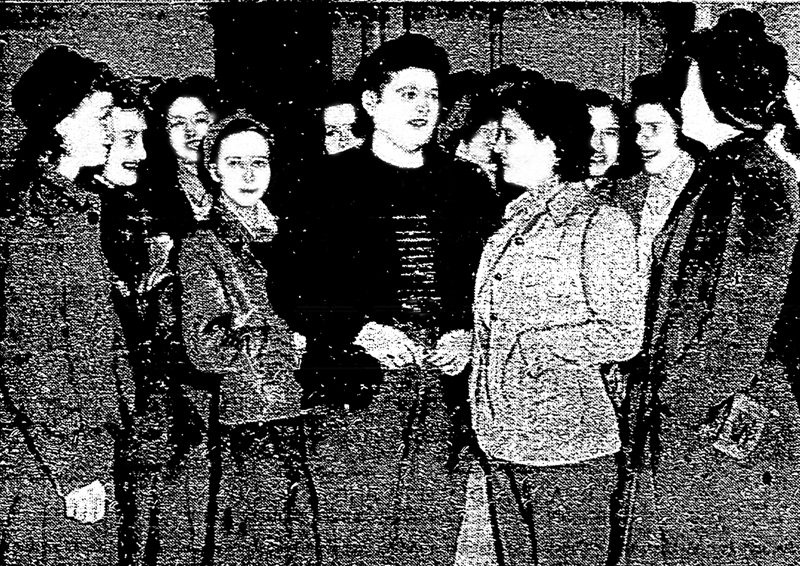
A group of 22 women welders and burners, representing hundreds barred from war production jobs in the new Marinship Corporation shipyards at Sausalito, stormed Boilermakers Local No. 6 offices in San Francisco at 155 Tenth Street on September 8, 1942, demanding the right to work. An account in the San Francisco Chronicle described the protest:
The feminine influx took the union Business Manager, Ed Rainbow, by surprise. His first reaction was belligerent. “If these girls attempt a publicity campaign against the union — an organization that seeks to protect women — we’ll yank all women workers out of the shipyards and let the government decide who’s right.”
All sides pointed fingers. Rainbow declared that adequate restroom facilities had not been installed, and Marinship said that they had. A spokeswoman for the protesters retorted: “If we want to walk a couple of extra blocks to a restroom that’s our business and not the union’s.”
Direct action worked. The next day’s news described how “The international headquarters of the union announced from Kansas City [that] the membership rolls of its 600 lodges would be opened to women.”
Even though a July 22 resolution for women’s membership yielded 12,000 votes for and 7,000 against, it failed on a quorum technicality. Union leadership then took the dramatic step of overriding their own bylaws on September 10, stating: “By authority of the Executive Council, you are directed to accept women, who are or who may become employed in jobs or work coming under the jurisdiction of our International Brotherhood, to membership.”
The doors were opened. By late November 1944, more than 3,000 women at the Kaiser Shipyards in Portland had received their union cards; a similar influx took place in Richmond.
That was then, and this is now. The arc of justice has moved forward, and the Boilermakers Union are major sponsors of the Rosie the Riveter World War II Home Front National Historical Park and are actively recruiting women in the trade.
-30-
Images:
Mary C. Carroll and Jeanne W. Wilde at Oregonship, 8/13/1942
Louise Cox
Photo, 9/9/1942, San Francisco Chronicle
Caption:
The Woman’s Touch: Local no. 6 of the Boilermakers’ Ship Builders, Welders, and Helpers felt the woman’s touch yesterday when these 20 be-slacked lady welders appeared at headquarters to protest their not being given union clearance for shipyard jobs. Only assurance they received from Business Manager Ed Rainbow was that the matter would remain in status quo until results of the international’s referendum on feminine membership were tabulated. The ladies were silenced but not satisfied.
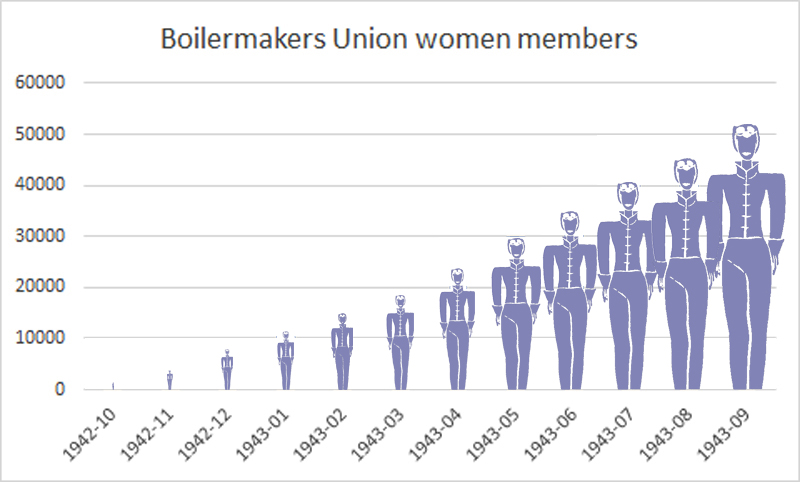
Graph of women’s employment in the Boilermakers Union, 1942-1943
[Boilermakers Union women membership; data from 1944 convention, chart by author. Of the above hires, 12,063 were lost in turnovers, leaving a membership of approximately 40,000 in fall 1943. Source: Proceedings of the Consolidated Convention of the International Brotherhood of Boiler Makers, Iron Ship Builders and Helpers of America, 1944]
Return to Docs Populi / Documents for the Public